The Skills-Based Organisation
— every role, every skill, one foundation.
Only 54% of leaders have a clear view of skills in their organisation. Without structured skills data, every talent decision — hiring, mobility, development, pay — is a guess. Cobrainer gives you the foundation to close that gap.







The impact is measurable.
57% more agile.
Skills-based organisations are 57% more likely to anticipate and respond to change — adapting to market shifts, AI disruption, and new business models faster than role-based structures.
Hidden talent, activated.
Internal mobility and cross-functional moves replace external hiring. When you see skills clearly, you find the people you already have — and redeploy them where they create the most value.
Fair and explainable pay.
Clear skill expectations and proficiency levels make career progression transparent. Compensation ties to what people actually do — not titles, tenure, or negotiation.
80% less manual work.
Cobrainer's AI generates your Job & Skill Architecture automatically — cutting the manual effort of building and maintaining role frameworks by up to 80%.
One foundation. Every talent decision.
A skills-based organisation runs on a single, continuously updated Job & Skill Architecture. Cobrainer generates and maintains every job, task, skill, and competency. Your HRIS consumes it. All use cases — from job architecture management to compensation to organisation agentification — draw from one trusted source. No silos. No inconsistency.
Assess. Compile what you have. Cobrainer works with messy, incomplete, or outdated job data. Wherever you are — that's where we begin.
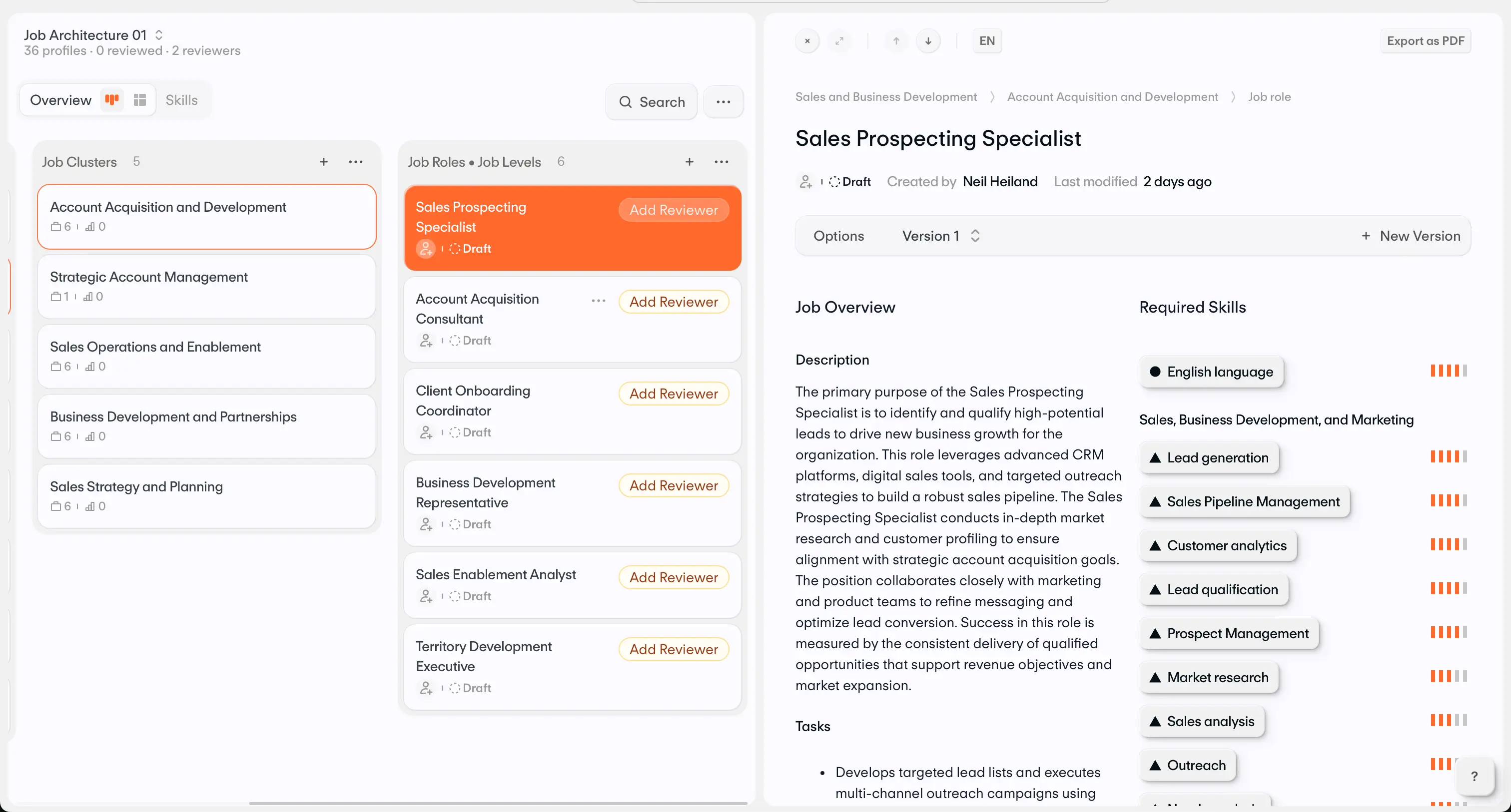
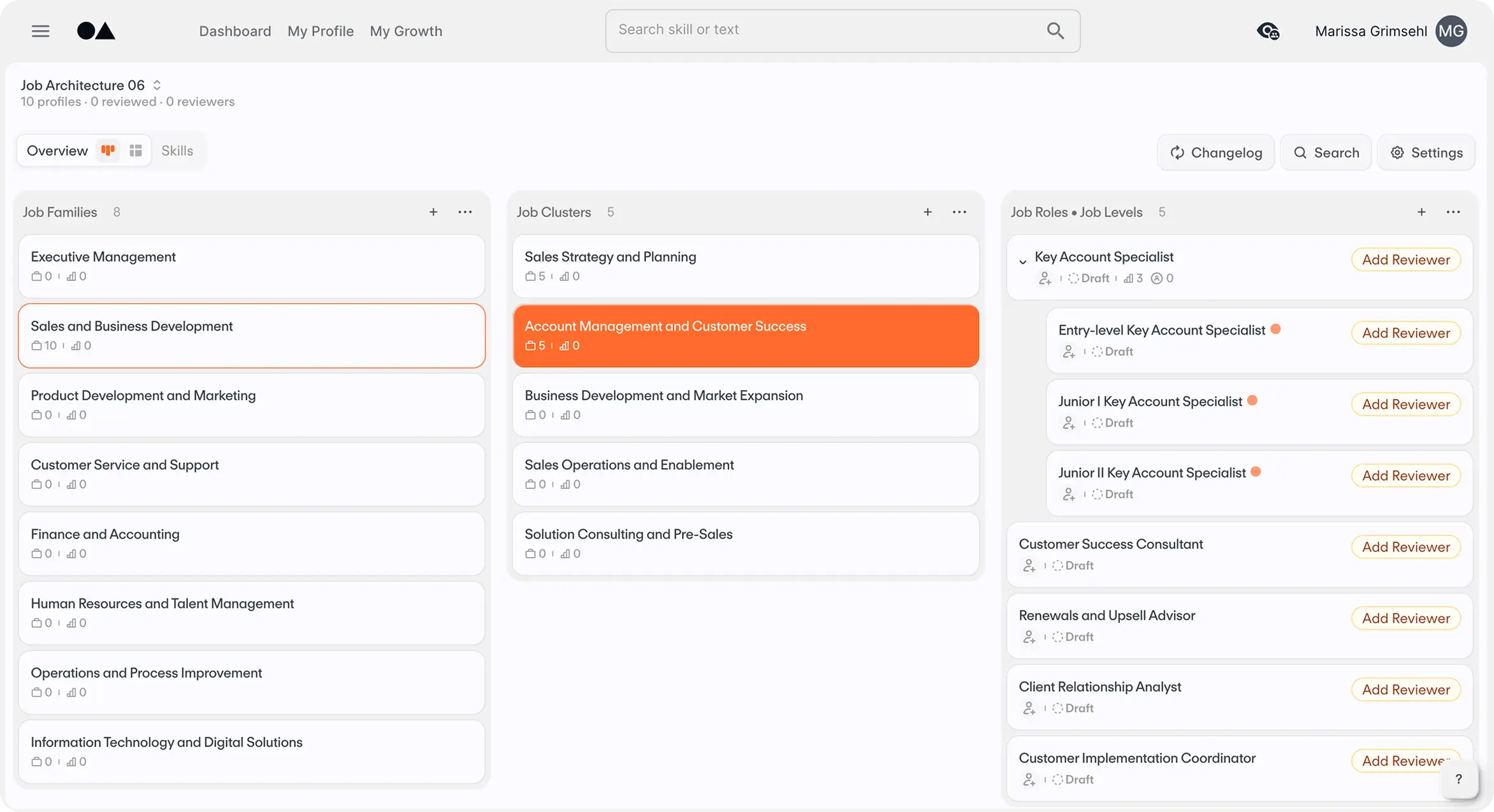
Build. AI generates your Job & Skill Architecture: job families, clusters, roles, skills, proficiencies. 80% less manual work than traditional approaches.
Integrate. Push your architecture directly into SAP SuccessFactors, Workday, or your HRIS. One architecture, all modules, always in sync.
Activate. Every talent process runs on the same skills foundation — hiring, onboarding, development, mobility, performance, and compensation.
11 use cases. One skills foundation.

- 1
Org planning & design
A clear map of all jobs, tasks, and skills lets leaders design teams with confidence. Workforce planning moves from spreadsheet guessing to structured, data-driven decisions.
- 2
Skill profiling
Employees see what is expected of them. Managers see what their teams can actually do. Accurate skill profiles based on real job requirements replace vague self-assessments.
- 3
Talent acquisition
Consistent, skill-based job profiles mean recruiters and candidates are aligned from day one. No more reinventing role descriptions with every open position.
- 4
Onboard
New hires see the skills, responsibilities, and expectations for their role immediately. Managers set people up with the right learning from the start — not after the first quarter.
- 5
Learning & development
Training tied to real job needs. Each role connects to the skills it requires, and those skills connect to relevant learning content — so development plans address actual gaps.
- 6
Career pathing & succession
People stay when they see a future. Transparent skill-to-role mapping shows which skills lead to which roles, and who is ready for the next step.
- 7
Internal mobility
Most organisations have great talent they simply overlook. A skills-based operating model surfaces internal candidates based on skill readiness and gives employees visibility into roles they can move into.
- 8
Performance management
Evaluations grounded in the skills and responsibilities of the role — not gut feeling or generic forms. Objective, consistent, and easier to explain.
- 9
Skill-based compensation
When roles, skills, and levels are clear, pay can be clear too. Skill-based compensation connects salary bands to real responsibilities — fair, consistent, and audit-ready.
The skills economy is here. Two-fifths of today's skills will be obsolete by 2030. Only 54% of leaders have a clear view of skills in their organisation. And 57% of skills-based organisations outperform their peers on agility. By adopting a skills-based operating model with Cobrainer, organisations build a dynamic Job & Skill Architecture, embed it into their HR systems, and transform every talent process — from planning and hiring to learning, mobility, and pay. One trusted data foundation. No perfect prerequisites required.
Start Transformation
Job & Skill Architecture generation
Automatic skills profiling, harmonizing and governance
Intelligent skills-driven, performance, development, goals, learning, recruiting and succession
Skills-driven planning, workforce transformation, human-agent-pairing
Continuous Transformation
From scattered data to continuous transformation — the skills maturity curve.
Assess what you have. Compile existing job profiles, role descriptions, and documents. Cobrainer works with messy or incomplete data — no perfect prerequisites required.
The organisation gains a structured foundation: job families, roles, tasks, skills, and proficiency levels — all in one place, aligned to how the business actually works.
Every employee has an accurate skill profile based on real job requirements. Duplicates are eliminated, naming is harmonised, and governance keeps the structure consistent as the organisation evolves.
Hiring, performance, development, learning, recruiting, and succession all run on a shared skills foundation — replacing disconnected, inconsistent processes with one trusted data source.
The organisation plans ahead with confidence: identify skill gaps, redesign roles for AI, support internal mobility, and get a clear picture of future capability needs.
Job and skill data stays alive. As roles shift and strategy evolves, the architecture updates automatically — keeping HR systems accurate and the organisation ready for what comes next.