
The AI to build your Job & Skill Architecture –
All roles, tasks, and skills ready in 1 hour.
Cobrainer is the Skills Platform that turns scattered information into an always up-to-date Job & Skill Architecture — ready to activate your HRIS and every talent process you rely on.







What is a Job and Skill Architecture?
A job and skill architecture is a structured framework that organizes every job in an organization into families, clusters, roles, and levels — with each role defined by specific skills, responsibilities, and proficiency requirements. It serves as the single source of truth for talent management, compensation, workforce planning, and organizational transformation.
Unlike an org chart, which only shows reporting lines, a job and skill architecture defines the work itself: what each role requires, how roles relate, and what skills power every position. Organizations with a structured job and skill architecture are 57% more likely to anticipate change, retain employees nearly twice as long through better internal mobility, and reduce manual HR work by up to 80%.
Job Architecture
A job architecture organizes all roles into a clear hierarchy of job families, job clusters, job roles, and job levels. It defines career paths, grading criteria, and the structural foundation for pay bands and compliance with directives like the EU Pay Transparency Directive.
Skill Architecture
A skill architecture maps every role to specific skills, competency clusters, and proficiency levels. It creates a machine-readable skills taxonomy that powers skills-based hiring, development, internal mobility, and compensation.
What is Skills AI?
Skills AI is artificial intelligence specifically designed to understand, map, generate, and manage job and skill data at scale. Cobrainer's Skills AI uses a patented Skills Graph with 170,000+ skills and millions of validated relationships to generate a complete job and skill architecture in under 1 hour — replacing months of manual consulting with automated, continuous architecture generation.
Why Cobrainer vs. Traditional Approaches
Consulting firms take 6–12 months. Cobrainer takes 1 hour.
Traditional job architecture projects with firms like Korn Ferry or Marsh require months of workshops, interviews, and manual documentation. Cobrainer's Skills AI automates the entire process — analyzing your existing data and generating a complete, tailored architecture in under 1 hour.
Taxonomy tools map roles. Cobrainer generates them.
Tools like Lightcast provide labor market taxonomies for mapping existing roles to external data. Cobrainer goes further: it generates the actual job and skill architecture from scratch — creating role definitions, skill profiles, job families, and levels, then integrating directly into your HRIS.
Native HRIS features offer generic skills. Cobrainer delivers yours.
Built-in skills features in SAP SuccessFactors, Workday, and ServiceNow provide generic skill libraries. Cobrainer generates a highly industry- and customer-specific skill set unique to your organisation — and powers the complete job architecture behind every connected talent module.
Four unique benefits.
Fully automated.
Build the first draft with our Skills and Jobs AI in days, not months.
Tailored to you.
Your jobs, your levels, your processes. No generic templates.
Always up-to-date.
Architecture updates continuously as roles and skills shift.
Integration ready.
Plug into SAP SuccessFactors, Workday, ServiceNow - or any HR system you run.



How most companies do transformation today.
.webp)
Endless Excel sheets, PowerPoints, and PDFs, each with scattered data, version chaos, and endless manual edits. Teams spend weeks chasing consistency, only to end up with frameworks that are outdated the moment you click "Save."

Cobrainer automatically analyzes your existing data, organizes and enriches it with 15 years of skills research from our patented Skills Graph - the most detailed source of job and skill data on the market.
The result is a precise, AI-built Job & Skill Architecture that stays current, reduces manual work by up to 80% and powers the HR system you already use.
How true transformation works with Cobrainer.
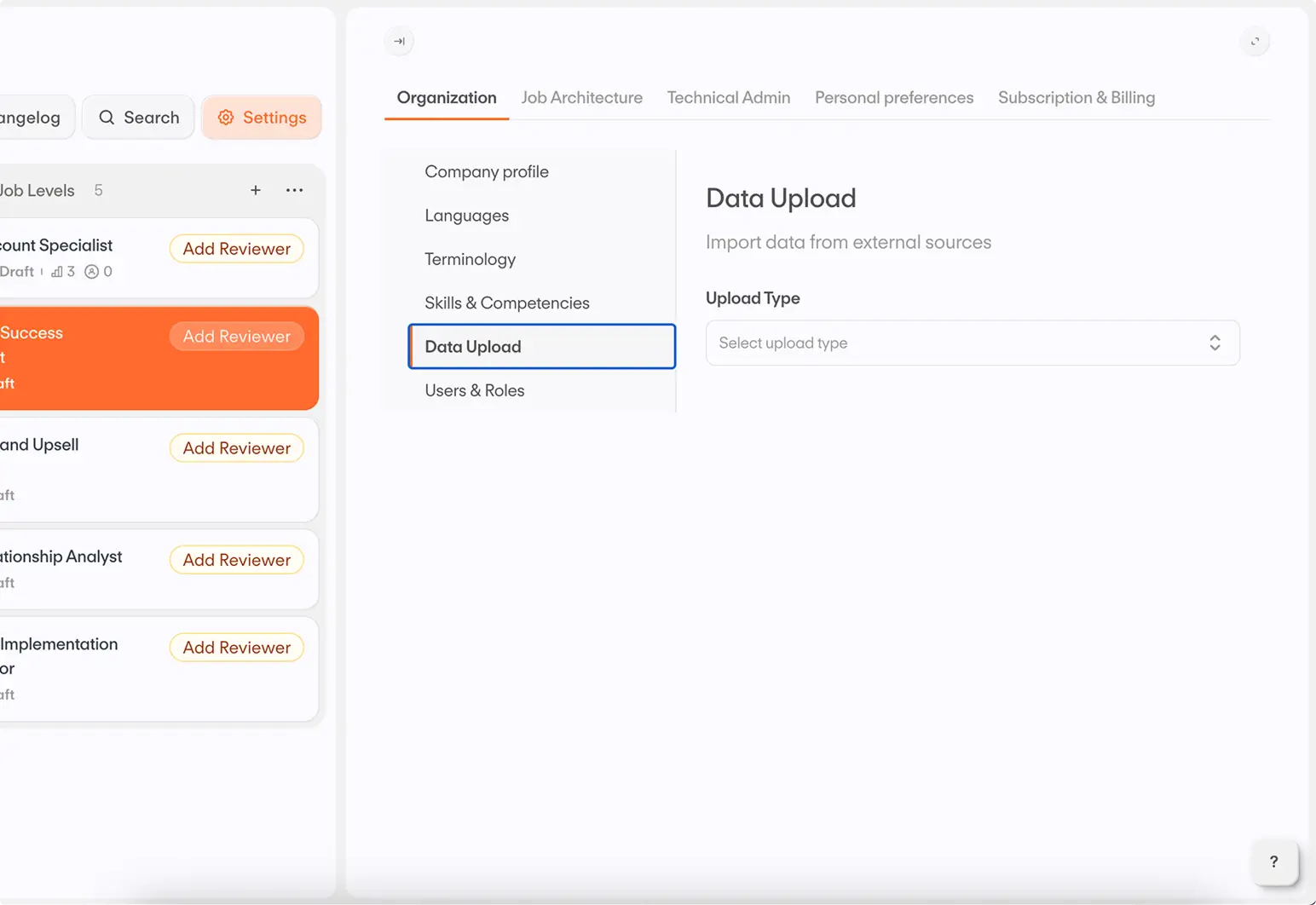
Upload your data. AI structures it.
Use scattered files as the foundation for your Job and Skill Architecture. Upload job profiles, org charts, strategy decks or even messy Excel sheets. Our AI turns it into structured data.
No data? No problem.
With a decade of experience and a patented Skills Graph of more than 170,000 skills, Clarity can generate a complete architecture from scratch — one that mirrors your real work, not a generic template.
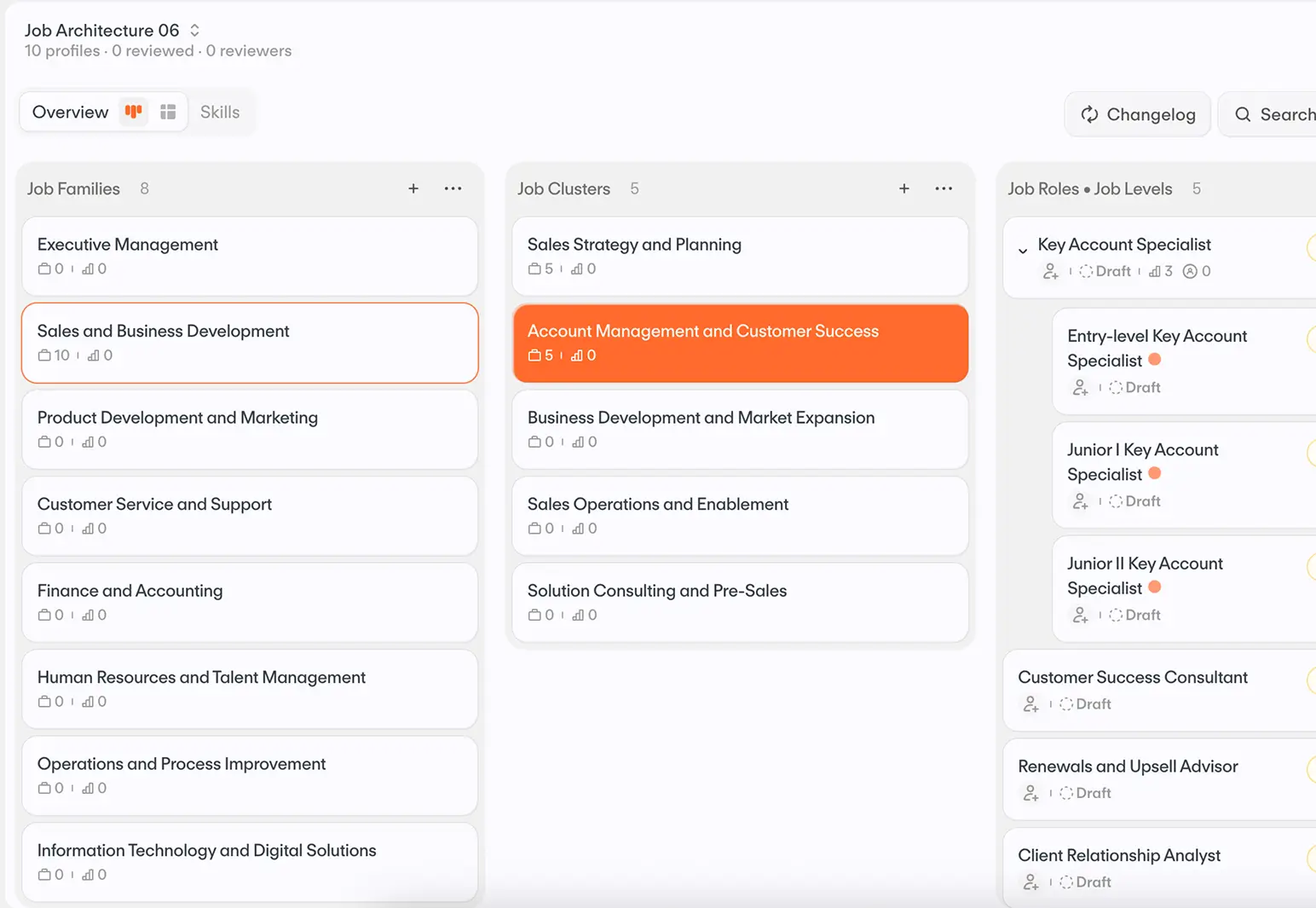
Watch as your custom Job and Skill Architecture is being generated.
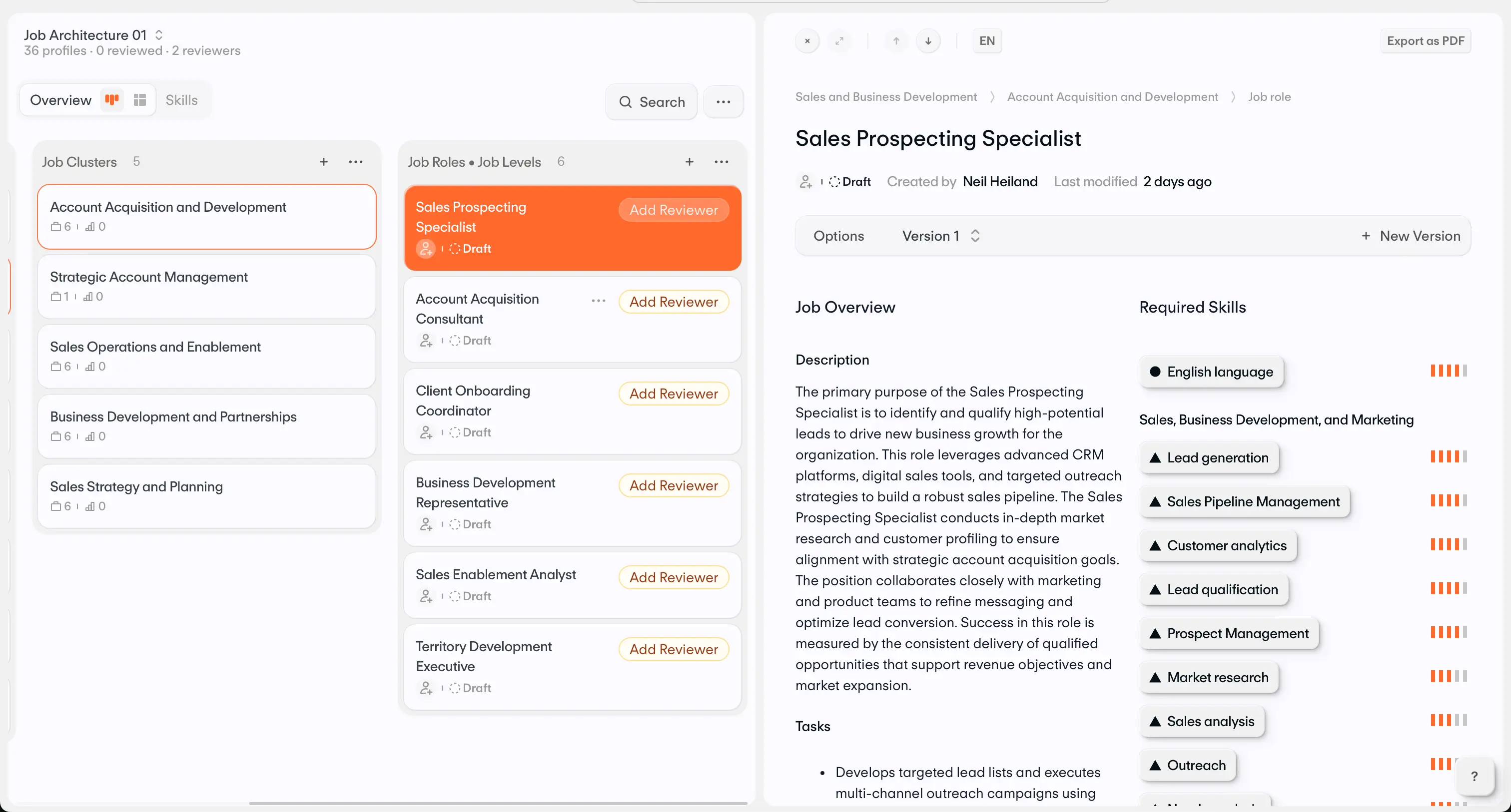
Cobrainer automatically groups roles and skills into coherent job families, aligned with your company's language.
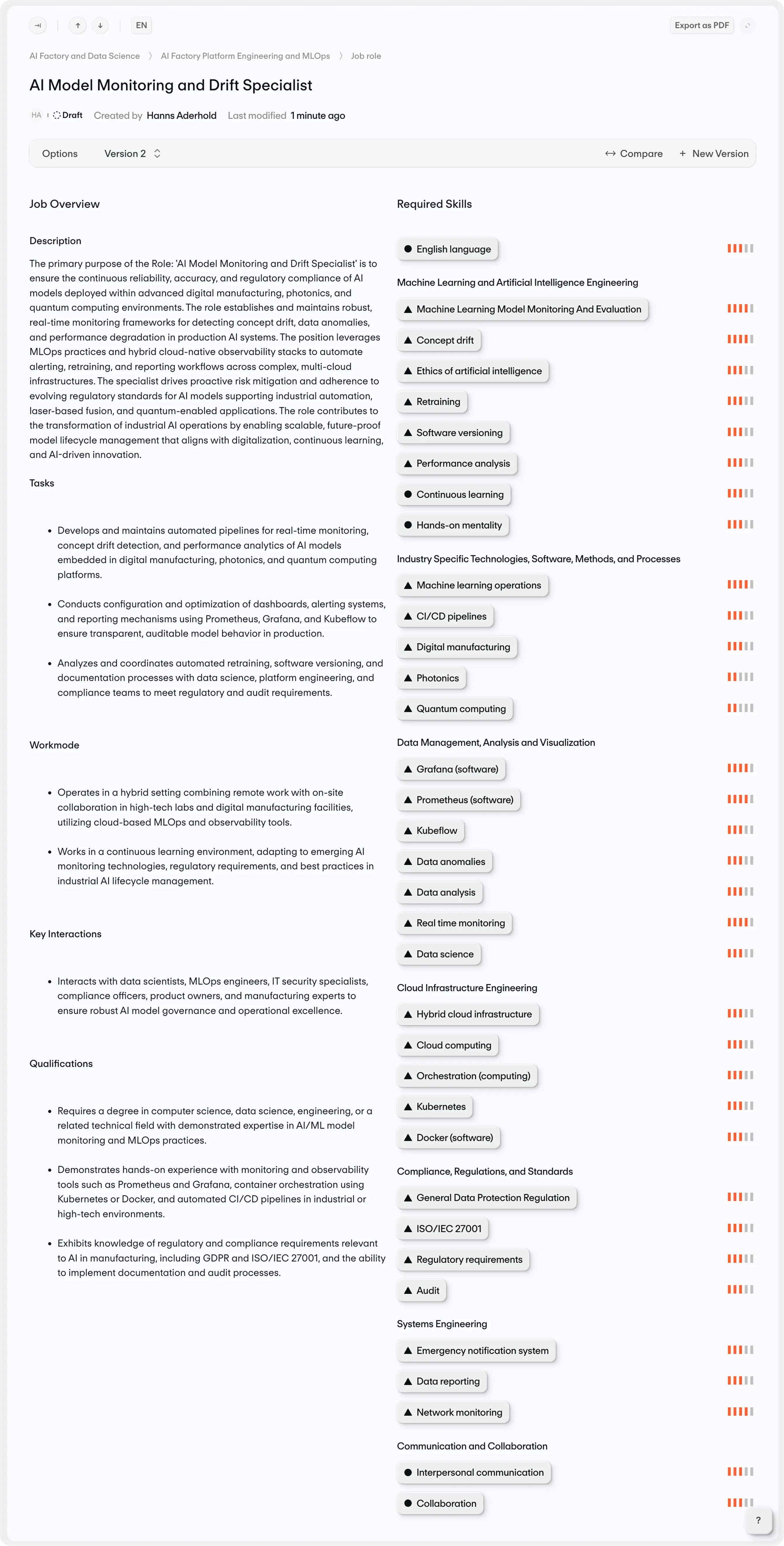
Every role is enriched with the right skills and proficiencies, ready to refine or regenerate whenever you need it.
The most accurate job roles and skill profiles — built on 170,000+ structured skills.
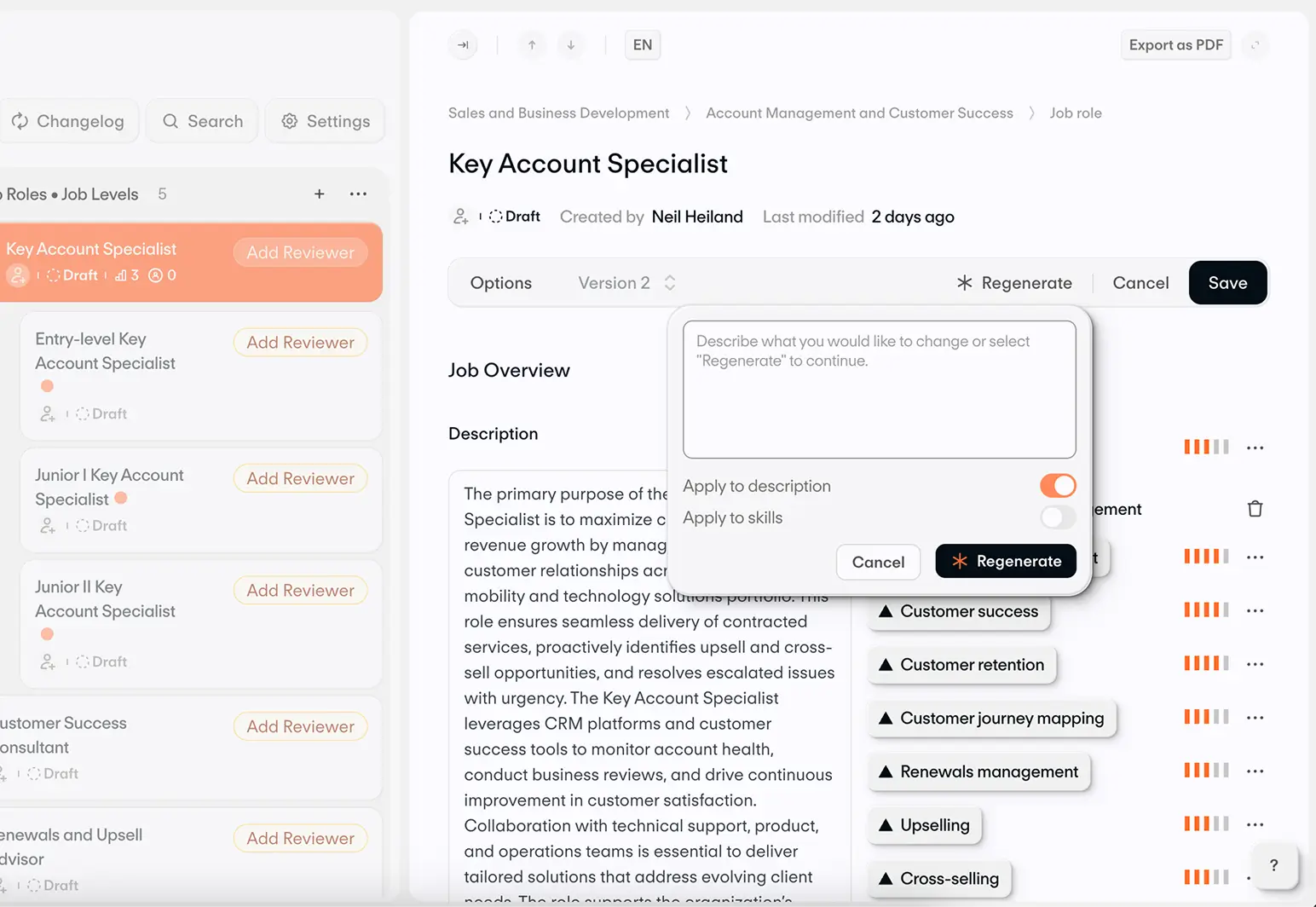
Save weeks with our AI review processes
Replace workshops with alignment. Cobrainer's review workflow helps managers and business leads agree on every job role description quickly and confidently.
What used to take weeks now takes hours and results in an always up-to-date architecture that's ready for hiring, development and transformation.
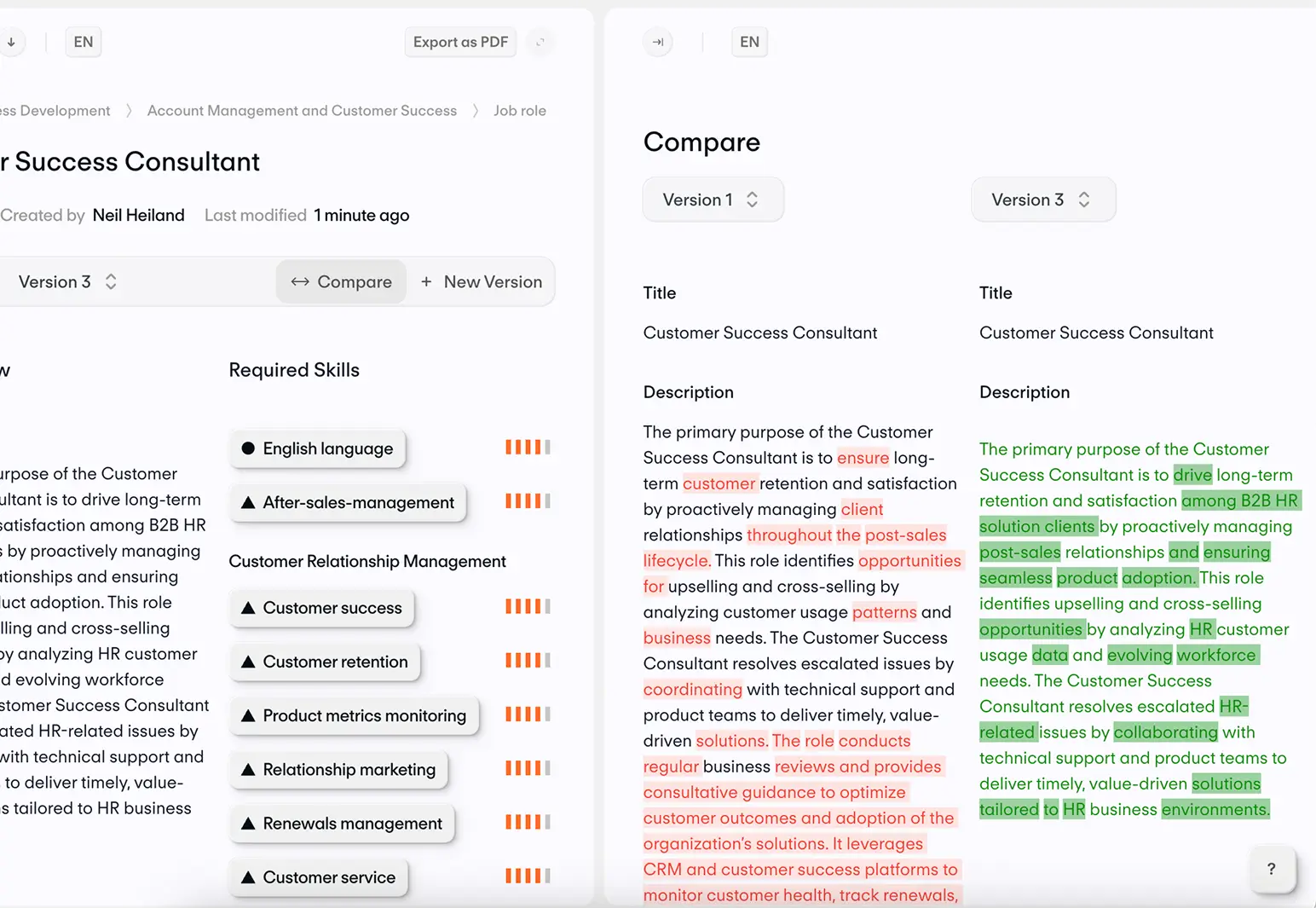
Keep track of different versions.
Every change is visible. Every update auditable. Cobrainer's versioning system records the full lifecycle of each job and skill profile — from draft to published. Compare versions, roll back edits and view a changelog of who changed what and when.
No confusion, no parallel files — just a clear, trusted evolution of your organization's roles and skills.
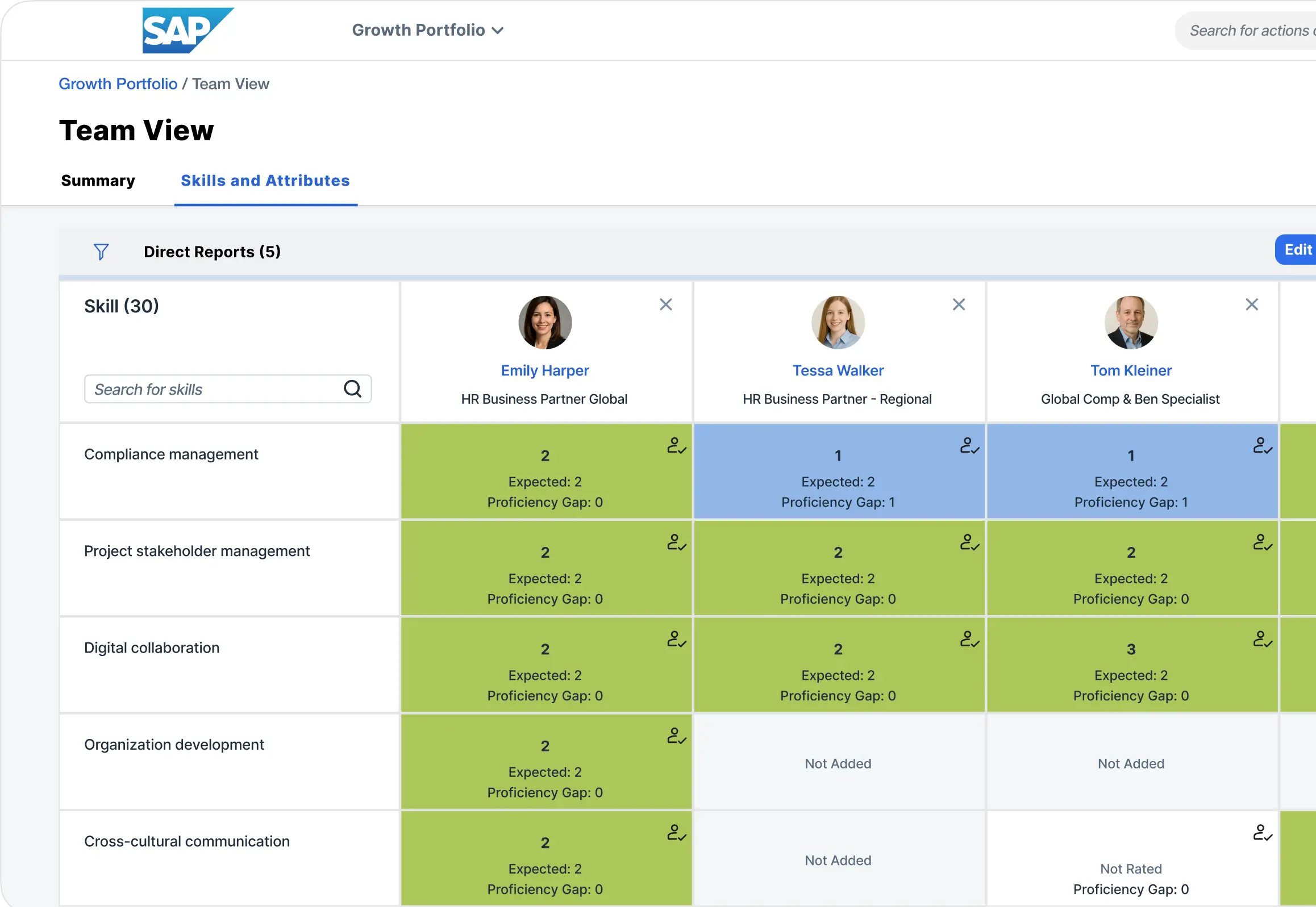
Use your Job and Skills Architecture to power your HRIS.
Make your JSA work where your employees do. Push it directly to SAP SuccessFactors, Workday or any connected HR system.
Cobrainer filters for what's truly relevant, keeping your skills library clean, consistent and business-critical.

SAP SuccessFactors Integration or visit the SAP Store for more Information.

Workday Integration or visit workday.com for more Information.

Frequently Asked Questions
What is a job and skill architecture?
A job and skill architecture is a structured framework that organizes all jobs in an organization into families, clusters, roles, and levels, with each role defined by specific skills, responsibilities, and proficiency requirements. It serves as the foundation for talent management, compensation, workforce planning, and organizational transformation.
How long does it take to build a job architecture with Cobrainer?
With Cobrainer's AI, a complete job and skill architecture can be generated in as little as 20 minutes. The platform uses your existing job profiles, role descriptions, and documents combined with a patented skills graph of 170,000+ skills to create a tailored architecture automatically.
What is the difference between a job architecture and an org chart?
An org chart shows reporting relationships and hierarchy. A job architecture defines the structure of jobs themselves — job families, roles, levels, skills, and career paths. While an org chart tells you who reports to whom, a job architecture tells you what each job requires and how roles relate to each other across the organization.
How does AI transformation affect job architecture?
AI transformation is rapidly changing skill requirements across every role. Traditional static job frameworks can't keep pace. An AI-powered job architecture like Cobrainer's continuously updates as roles and skills shift, ensuring your organization design stays current with market demands and technology changes.
What is a skills-based organization?
A skills-based organization structures its talent processes around skills rather than traditional job titles or hierarchies. It uses a clear job and skill architecture to make decisions about hiring, development, compensation, mobility, and workforce planning based on objective skill data rather than subjective criteria.
What is a skill architecture?
A skill architecture maps every role in an organization to specific skills, competency clusters, and proficiency levels. It is the skills layer of a job and skill architecture — defining not just what jobs exist, but what capabilities each role requires. Cobrainer generates skill architectures automatically using a patented Skills Graph with 170,000+ skills and millions of validated real-world relationships.
What is a job architecture?
A job architecture organizes all roles in a company into a clear structure of job families, job clusters, job roles, and job levels. It defines what each role requires, how roles relate to each other, and what career paths exist. Unlike an org chart, a job architecture is about the work itself — not reporting lines. Cobrainer's AI generates tailored job architectures from your existing data in under 1 hour.
How does Skills AI generate a job and skill architecture?
Cobrainer's Skills AI analyzes your existing job data — job descriptions, role documents, org charts, even messy spreadsheets — and structures it using a patented Skills Graph containing 170,000+ skills. The AI groups roles into coherent job families, assigns accurate skill profiles with proficiency levels, and generates a complete job and skill architecture. The process takes as little as 20 minutes and replaces months of manual consulting work.